
Lower Blepharoplasty for Under-Eye Hollows
Lower blepharoplasty for under-eye hollows is a surgical procedure that addresses volume loss in the tear trough, the area between the lower eyelid and the cheek. Rather than removing fat, the surgeon repositions the patient's own fat pads over the orbital rim to fill the hollow, smoothing the transition from lid to cheek and giving a more rested, natural appearance.
Mr Aftab Ahmed performs lower blepharoplasty for under-eye hollows for patients suffering from tear trough hollowing, under-eye shadows and a tired appearance in cosmetic clinics in Nottingham and Doncaster.
What Causes Under-Eye Hollows?
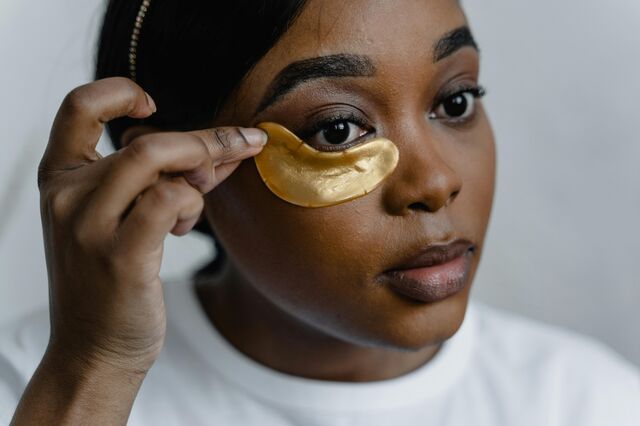
Under-eye hollowing can arise from several overlapping causes, and understanding which is dominant in each patient shapes the surgical approach.
Cause
Description
Surgical Solution
Tear trough ligament prominence
The ligament attaching the eyelid to the bone creates a visible groove
Release of the ligament and fat repositioning
Volume loss in the tear trough
Age-related fat atrophy beneath the orbital rim
Fat repositioning or fat grafting
Fat prolapse above creating a shadow
The bag above the hollow casts a shadow that deepens the apparent hollow
Fat repositioning addresses both simultaneously
Midface descent
The cheek falls away from the lower eyelid
May require midface lift in severe cases
Genetic predisposition
Some patients have naturally deep tear troughs from a young age
Fat repositioning or fat grafting
What is Lower Blepharoplasty for Under-Eye Hollows?
Lower blepharoplasty for under-eye hollows is a surgical procedure that addresses the tear trough depression through one of two primary methods: repositioning existing lower eyelid fat over the orbital rim into the hollow, or grafting fat harvested from elsewhere in the body into the tear trough area.
The choice between these two approaches depends on how much fat is available in the lower eyelid compartments and whether there is also a fat bag present that can be usefully redirected.
Approach Options
Approach
When It Is Used
Key Advantage
Fat repositioning
Fat bag present alongside the hollow
Addresses both bag and hollow simultaneously
Fat grafting
Hollow without significant fat prolapse
Adds volume where none is available to reposition
Combined approach
Partial repositioning with additional grafting
Used when repositioned fat alone is insufficient
The Surgical Tools Used
Arcus Marginalis Release
- Fine scissors or Colorado needle for releasing the arcus marginalis precisely
- Loupe magnification to work safely at the orbital rim
- Periosteal elevator to create the pocket for the repositioned fat
Fat Grafting Instruments (where used)
- Harvest cannulas for collecting fat from a donor site such as the abdomen or flank
- Centrifuge to process and purify the harvested fat before injection
- Fine injection cannulas for precise placement of fat in the tear trough
Fixation
- Fine absorbable sutures to secure repositioned fat to the periosteum
- Multiple fixation points to ensure the fat lies flat and smooth without bunching
Is Lower Blepharoplasty for Under-Eye Hollows Right for You?
Who Makes a Good Candidate?
- Men and women with a clearly visible tear trough depression causing a tired or sunken appearance
- Those who have had repeated filler treatments in the tear trough and want a more permanent solution
- Patients with both a fat bag and a hollow who are seeking a single procedure to address both
- Individuals with a genetic predisposition to tear trough hollowing who have had this concern since their twenties or thirties
What to Expect: Recovery Week by Week
Days 1 to 3: Immediate Recovery
- Swelling and bruising around the eyes and into the cheek area
- Cold compresses and head elevation are essential
- Lubricating eye drops as directed
- The treated area may feel firm and appear over-corrected initially, which is normal
Days 4 to 7: Early Progress
- Bruising begins to fade and swelling reduces
- The lower eyelid area begins to settle
- Sutures removed if a transcutaneous approach was used
Week 2: Returning to Normal
- Most patients return to work and social activities
- Makeup can be applied from around day ten
- The improvement in the tear trough area begins to become apparent
Weeks 3 to 4: Resuming Daily Life
- Light exercise can be reintroduced
- The repositioned or grafted fat begins to integrate
- The hollow appears progressively less visible
Months 2 to 6: Final Results
- Fat repositioning results are fully integrated and stable
- Fat grafting results settle as any reabsorption of grafted fat reaches equilibrium, typically at three to six months
- The smooth lid-cheek transition is clearly established
Clinical Outcomes: What to Expect Long Term
- Fat repositioning: Produces a permanent correction as the patient's own tissue integrates fully at the orbital rim
- Fat grafting: The surviving fat is permanent, though some reabsorption occurs in the first three to six months, which is why slight overcorrection is planned for
- Natural appearance: Using the patient's own tissue avoids the risk of migration, Tyndall effect, or the artificial appearance associated with repeated filler
- Satisfaction: High, particularly in patients who have struggled to achieve lasting improvement with injectable treatments
Potential Risks and Considerations
Common and Temporary
- Swelling and bruising around the eyes and upper cheek
- A feeling of firmness or slight overcorrection in the tear trough area that resolves as swelling settles
- Temporary dry eye or altered tear production
Less Common Risks
- Asymmetry between the two sides if fat volume is not equal
- Lumpiness or irregularity in the tear trough if fat grafting is not placed smoothly
- Reabsorption of a greater than expected proportion of grafted fat, requiring a second session
Rare Risks
- Vascular occlusion from fat grafting in the periorbital area, extremely rare but requiring immediate assessment
- Haematoma within the orbit
Financial Considerations
- Fat grafting involves harvesting from a donor site, adding to the procedure time and cost
- A second fat grafting session may be needed if reabsorption is significant
- Time off work, typically one to two weeks
- Follow-up appointments to monitor integration and symmetry
Lower blepharoplasty for under-eye hollows offers a permanent, natural solution to one of the most common and difficult-to-treat concerns in the lower eyelid area. When the correct technique is matched to the patient's anatomy, the result is a smooth, rested lid-cheek junction that looks entirely natural and lasts without maintenance.
Struggling with hollows beneath your eyes that filler cannot fully resolve? Book a consultation to explore your surgical options.

Mr A Ahmed
MB ChB, MRCS, FRCS (ORL-HNS)Mr Ahmed has trained as an ENT Surgeon with subsequent Fellowship training in Facial Plastic & Reconstructive Surgery in America and Europe.




EAFPS
European Academy Fellowship of Facial Plastic and Reconstructive Surgery
RCSEd
Fellow of the Royal College of Surgeons of Edinburgh
ENT UK
The professional membership body promoting excellence in ENT
Book my Consultation

Book a consultation now, fill in your details and we’ll call you back. Start discovering your true self today.
Our opening hours are Monday to Friday 9am-7pm.
- Get to know Mr Ahmed
- All your questions answered
- Get procedures recommendations
- Get advice on next steps
Facial Plastic Surgeon Nottingham – The Park Hospital
The Park HospitalSherwood Lodge Drive
Burntstump Country Park
NG5 8RX Find out more
Facial Plastic Surgeon Nottingham – Woodthorpe Hospital
Woodthorpe Hospital748 Mansfield Road
Nottingham
NG5 3FZ Find out more